
AI Search Explained: How Google AI Search Is Changing SEO and Website Traffic
Search is not the same anymore. For years, Google Search was mostly about keywords, links and rankings. Today, AI Search is changing that experience in a big way. Google is now combining traditional search with AI-generated answers, conversational follow-ups and multimodal understanding, which means users can search with more context and get more direct help inside the results page itself. Google says AI Overviews now reach 2 billion users every month, which shows how quickly this format has scaled.
Google has also said that AI in Search is driving more queries and that people are asking longer, more complex questions. At the same time, Google says overall organic click volume has stayed relatively stable year over year, while third-party studies are reporting noticeable CTR changes where AI Overviews appear. That tension is exactly why this topic matters for SEO, content strategy and website traffic.
As a Digital Marketer, I find this shift especially important because it is not just a product update. It changes how users search, how brands get discovered and how content needs to be written if it wants to stay visible in an AI-driven search environment.
AI Search is moving from “finding links” to “answering questions”
AI Search is built to understand intent, context, and follow-up needs, not just keyword matches. Google’s AI Mode uses query fan-out, where one question is broken into multiple subtopics and searched in parallel, which helps generate richer answers. Google also says AI Mode queries are on average twice as long as traditional search queries, showing that users are typing more exploratory questions than before.

AI Overviews are already mainstream
Google’s latest public figure says AI Overviews now have 2 billion users per month. That is a massive scale for any search feature and it tells us that AI Search is no longer experimental in the way most people think of it. It is already part of the everyday search experience for a huge audience.
CTR is not behaving the way old SEO expected
A Search Engine Journal report found that the top organic result dropped from 28% CTR to 19% CTR, which is a 32% decline, after AI Overviews expanded. The same study reported that AI Overviews appeared for just 10,000 keywords in August 2024 but by May 2025 that number had climbed to over 172,000 keywords. That is a clear sign of rapid expansion.
Zero-click behavior is becoming more common
A randomized field experiment reported by Search Engine Journal found that AI Overviews reduced outbound organic clicks by 38% on queries where they appeared. It also found that zero-click searches rose from 54% to 72% when AI Overviews were shown. In the same study, AI Overviews appeared on 42% of queries, which is a strong signal that this is not a rare user experience anymore.
Google’s own view is more optimistic than third-party studies
Google says it still sends billions of clicks to websites every day and that overall organic click volume has been relatively stable year over year. Google also says that AI Overviews can create more opportunities for websites because people are searching more, asking longer questions, and seeing more links on the page. In Google’s framing, the web and AI are meant to work together, not replace each other.
The search experience is becoming more visual and conversational
Google has also expanded AI Mode with multimodal search, meaning users can upload an image or snap a photo and ask questions about what they see. Google says AI Mode can understand the whole scene, including objects, materials, colors and shapes, and then respond with links and follow-up options. That is a huge change from traditional text-only search.
1. Google AI Overviews now reach 2 billion users monthly
This is probably the clearest sign that AI Search has become a core part of Google’s future. A product that reaches 2 billion monthly users is no longer a side experiment. It is a mainstream search surface that SEOs have to think about seriously.
2. Google says AI Mode queries are 2x longer
Longer queries usually mean users are searching with clearer intent and more context. Google’s own data says AI Mode searches are, on average, twice as long as traditional queries. That suggests a growing shift toward conversational search behavior, where people ask fuller questions instead of typing short keywords.
3. AI Overviews can reduce clicks, but not always user satisfaction
In the randomized field experiment covered by Search Engine Journal, AI Overviews cut organic clicks by 38%, while zero-click searches increased from 54% to 72%. Interestingly, removing AI Overviews did not significantly change satisfaction or ease of finding information. That matters because it suggests some users are getting what they need without ever visiting a website, even when the page still matters in the information chain.
4. Organic CTR can fall sharply when AI Overviews appear
Search Engine Journal’s CTR analysis found that the top-ranking result fell from 28% to 19% CTR, and position #2 also dropped from 20.83% to 12.60%. The study analyzed more than 200,000 keywords across 30 websites in ecommerce, SaaS, B2B and EdTech. For SEOs, that means a strong ranking alone may not deliver the same traffic level it used to.
5. Google is still trying to keep the web visible
Google says it is adding more ways to surface links inside AI Search. In its latest update, Google highlighted inline links, an “Explore new angles” area and subscription labels for publishers. That shows Google knows publishers need a path to traffic, even as AI answers become more common.
6. The content that benefits most is original, useful, and trustworthy
Google says users are more likely to click into in-depth reviews, original posts, unique perspectives, and thoughtful first-person analysis. That lines up strongly with EEAT. If content is generic, thin or repetitive, it will struggle in a search environment where AI can already summarize the obvious parts.
| Metric | Number | Why it matters |
|---|---|---|
| AI Overviews monthly users | 2 billion | Shows scale and mainstream adoption. |
| AI Mode query length | 2x longer | Shows conversational search behavior. |
| AI Overviews appearance in study | 42% of queries | Shows how often AI summaries appear. |
| Organic click reduction | 38% | Shows traffic impact on external websites. |
| Zero-click searches | 54% to 72% | Shows how often users stay inside the results experience. |
| Top organic CTR | 28% to 19% | Shows ranking alone is no longer enough. |
| AI Overview keyword coverage | 10,000 to 172,000 | Shows rapid expansion over time. |
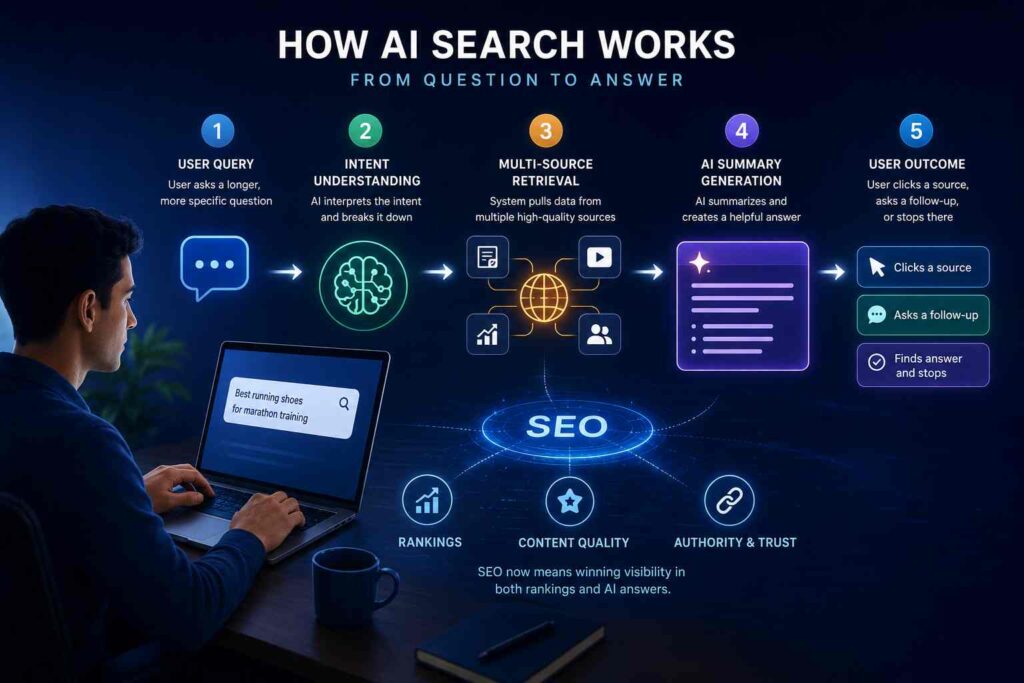
How AI Search changes SEO
- User asks a longer, more specific question.
- Google AI Mode or AI Overviews interprets the intent.
- The system pulls from multiple sources and summarizes the answer.
- The user either clicks a source, asks a follow-up or stops there.
- SEO now has to win both rankings and visibility inside AI answers.
Traditional Search vs AI Search
| Traditional Search | AI Search |
|---|---|
| Keyword match | Intent understanding |
| List of blue links | AI-generated response plus links |
| Short queries | Longer, conversational queries |
| Multiple searches | Follow-up questions in one flow |
| Traffic mainly from ranking | Traffic influenced by AI visibility and citations |
Interestingly, many of the trends discussed in this article were reinforced during Google Marketing Live 2026. In a recent article, I analyzed Google’s latest AI-driven updates, including AI Max, Demand Gen, Performance Max and Universal Commerce Protocol, and how they may influence the future of search, advertising and customer acquisition.
AI Search is not just changing how search looks. It is changing how search behaves. Google’s latest numbers show huge adoption, with AI Overviews reaching 2 billion monthly users and Google’s own product updates show a clear shift toward longer queries, multimodal search and more conversational interactions. At the same time, third-party research shows measurable traffic effects, including a 32% CTR drop for the top result in one study and a 38% reduction in organic clicks in another.
For SEO, the message is simple: ranking still matters but it is no longer the whole game. Brands now need content that is original, specific, experience-based and trustworthy enough to be surfaced inside AI-driven results. Google itself says the pages most likely to benefit are the ones that offer in-depth reviews, unique perspectives and first-hand analysis. That is where EEAT becomes practical, not just theoretical.
Connect With Me
Thank you for reading.
I’m Anupam Das, an MBA trainee specializing in Digital Marketing with a strong interest in SEO, AI Search, Performance Marketing, Marketing Automation, and emerging technologies shaping the future of digital marketing.
Through this blog, I share research-backed insights, industry trends, practical learning experiences and my observations on how technology is transforming search, advertising, and online visibility.
If you found this article helpful, feel free to connect with me and follow my journey:
🌐 Website: https://dasanupam.com/
💼 LinkedIn: https://www.linkedin.com/in/digi-anupam/
📧 Email: [email protected]
I regularly publish content on SEO, AI Search, Digital Marketing, Marketing Automation and the evolving relationship between artificial intelligence and search engines.
Need Help Implementing These Strategies?
As AI continues to reshape search, advertising and customer acquisition, many businesses are finding it difficult to keep pace with rapidly changing platforms and technologies. Through dasanupam.com, I help businesses improve their online visibility through SEO, content strategy, website optimization and digital marketing consulting.
If you’re looking to strengthen your digital presence or explore AI-driven marketing opportunities, feel free to explore my services:
Pingback: Google Marketing Live 2026: AI Is Becoming the OS of Digital Marketing - Anupam Das DIgital Marketing
Pingback: YouTube Keyword Research in 2026 - Anupam Das DIgital Marketing
Pingback: Google Analytics 4 in 2026 | Latest GA4 Updates | Anupam Das
Pingback: OpenAI Dots: 7 Powerful Features, Uses & Limits | Anupam Das