Google Marketing Live 2026: AI Is Becoming the OS of Digital Marketing
Every year, marketers eagerly wait for Google Marketing Live to understand where Google’s advertising ecosystem is heading. Most years bring incremental improvements. A new bidding strategy appears. A reporting feature gets upgraded. An ad format receives additional placements.
Google Marketing Live 2026 felt different.
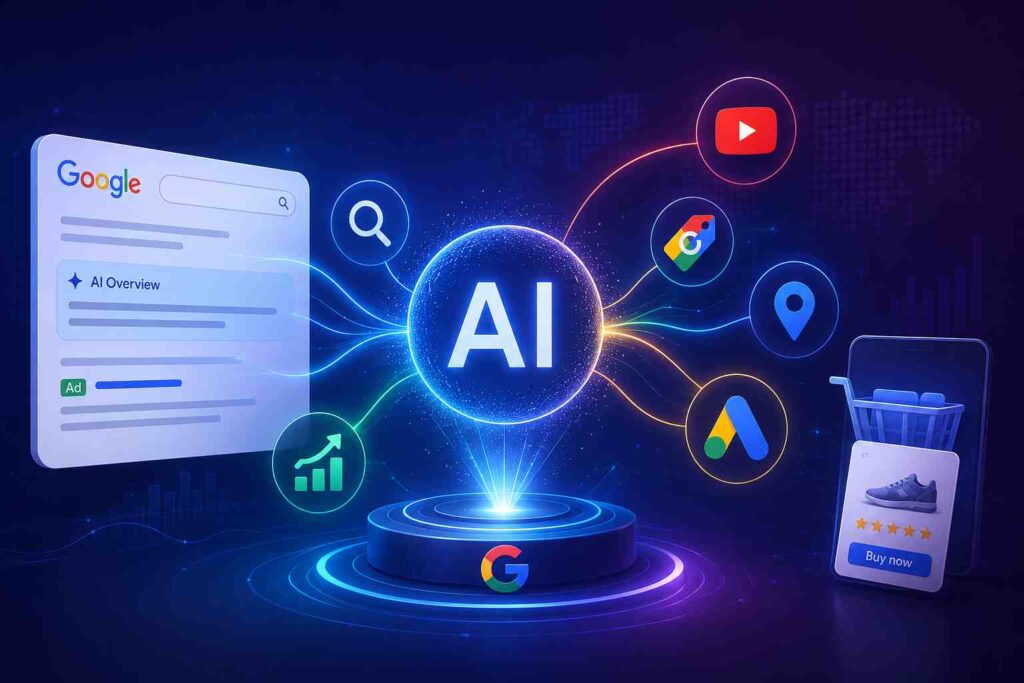
After attending the event and reviewing the announcements, one thing became clear: Google is no longer adding artificial intelligence to its advertising products. Instead, Google Ads, Search, YouTube, Shopping and even Maps are being rebuilt around AI.
The conversation is no longer about whether marketers should use AI in digital marketing. The real question is how quickly marketers can adapt to an ecosystem where artificial intelligence influences campaign targeting, creative production, customer discovery, attribution and purchasing decisions.
This transformation is not limited to advertising. Search itself is evolving rapidly through AI-powered experiences. In my previous article, AI Search Explained: How Google AI Search Is Changing SEO and Website Traffic, I explored how AI Overviews, AI Mode and conversational search are reshaping user behavior and online visibility.
For years, digital marketing relied heavily on keywords, manual campaign management and channel-specific optimization. Google Marketing Live 2026 suggests that future success will depend more on audience understanding, first-party data, creative strategy and the ability to guide AI systems effectively.
This shift affects every major area of online marketing including AI search, Google Ads AI, AI performance marketing, AI digital advertising and AI-driven customer acquisition.
For marketers, agencies and business owners, the implications are enormous.
Key Takeaways From Google Marketing Live 2026
Before diving deeper into the announcements, here are the biggest insights that stood out:
- AI Max is gradually becoming the future of Search advertising.
- Demand Gen campaigns are expanding into Google Maps.
- Product feeds are becoming more important across YouTube and Shopping experiences.
- AI-generated creative production is accelerating.
- Attribution and measurement are becoming more intelligent.
- Universal Commerce Protocol (UCP) could reshape ecommerce discovery.
- Search, Shopping and advertising are becoming increasingly connected.
- AI is reducing manual campaign management while increasing the importance of strategic thinking.
Most importantly, Google appears to be shifting from keyword-first advertising to intent-first advertising.
That may be the biggest transformation digital marketing has seen since mobile advertising emerged.
Why Google’s AI Strategy Matters More Than The Features
Many blog posts covering Google Marketing Live focus exclusively on features.
AI Max.
Performance Max.
Demand Gen.
Maps Ads.
Smart Bidding.
Those features matter.
However, focusing only on individual product announcements misses the bigger story. Google’s strategy is becoming increasingly obvious. User behavior has changed. Search queries are becoming longer. Consumers expect personalized recommendations. Users move seamlessly between Search, YouTube, Maps and Shopping.
Traditional campaign structures were designed for a world where marketers controlled every keyword and placement manually. That world is disappearing. Google’s AI ecosystem is being designed to understand intent rather than simply matching keywords. This evolution mirrors the changes we discussed in our article on AI Search and SEO, where AI-powered search experiences are reshaping how users discover information online.
The same transformation is now happening inside advertising.
AI Max: Google’s Vision For The Future Of Search Advertising
Among all the announcements, AI Max may have the greatest long-term impact on Google Ads. Historically, Search campaigns relied on keyword matching.
Advertisers spent years refining:
- Exact match keywords
- Phrase match keywords
- Negative keyword lists
- Search query reports
AI Max changes that approach.
Instead of relying primarily on keywords, Google’s AI evaluates:
- Search intent
- Website content
- Creative assets
- Audience signals
- Conversion behavior
- Landing page relevance
Google reported that advertisers using AI Max have achieved an average increase of 7% in conversions while maintaining similar CPA or ROAS levels.
Early testing showed gains closer to 14%.
Campaigns heavily dependent on exact match keywords saw improvements of up to 27%.
Those numbers are impressive. The strategic implication is even more important. Keywords are gradually becoming signals rather than instructions. The machine increasingly determines how users and advertisers should connect.
For marketers using Google Ads AI, this means success will depend less on keyword expansion and more on high-quality creative assets, strong landing pages and accurate business objectives.
In my previous article, AI Search Explained, I explored how AI Overviews, AI Mode and other AI search technologies are influencing visibility, traffic and SEO strategies.
AI Brief: Solving One Of Automation’s Biggest Problems
One concern many marketers have expressed about automation is losing control over brand messaging. Google appears to have recognized this challenge.
AI Brief allows advertisers to provide strategic guidance to Google’s AI systems before campaign optimization begins.
Brands can communicate:
- Tone of voice
- Messaging priorities
- Product positioning
- Creative preferences
- Campaign objectives
This may seem like a small feature. But it is not!!
As AI becomes more involved in campaign execution, marketers will increasingly shift from campaign builders to AI trainers. The brands that provide better strategic guidance will likely outperform brands that simply activate automation and hope for the best.
Demand Gen Is Growing Into A Full-Funnel Advertising Platform
Demand Gen campaigns have evolved rapidly since launch. Originally designed for visual discovery environments, Demand Gen now appears to be expanding into a much broader customer acquisition platform. One of the most interesting announcements from Google Marketing Live 2026 was the expansion of Demand Gen inventory into Google Maps.
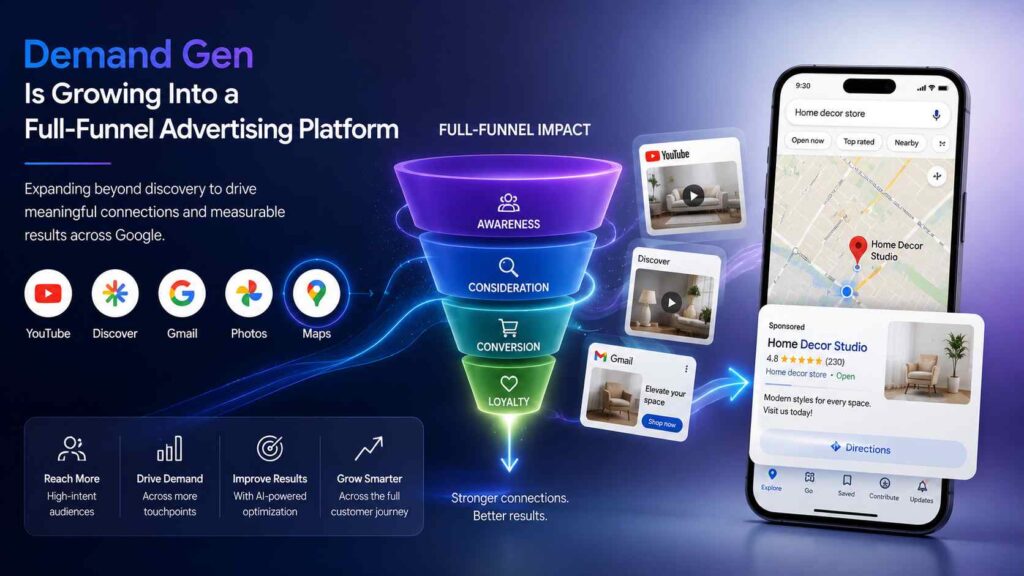
At first glance, this may not seem revolutionary. In reality, it could become one of the most valuable placements Google offers. Consider user intent.
A person browsing social media may not be planning to buy anything.
A person searching Maps for restaurants, coffee shops, gyms or electronic stores is much closer to making a purchase decision.
That difference matters.
Google reported that advertisers using Demand Gen with expanded inventory saw approximately 9.5% higher ROI. Brands utilizing product feeds achieved conversion increases of roughly 33%. These numbers suggest that Demand Gen is evolving beyond awareness campaigns and becoming a genuine performance marketing solution. For marketers focused on AI performance marketing, this is a development worth watching closely.
Why Google Maps Advertising May Become Underrated
One announcement that received less attention than AI Max deserves was the growing role of Google Maps advertising. Maps represents a unique environment. Unlike traditional advertising channels, Maps often captures consumers during moments of high commercial intent.
Someone is searching:
“coffee near me”
“best laptop store”
“fitness center nearby”
is often much closer to conversion than a user casually scrolling social media. As Demand Gen expands into Maps, businesses gain the ability to influence customer decisions during critical moments in the purchase journey. Local businesses may benefit enormously from this change.
For marketers managing AI digital advertising campaigns, Maps could become one of the most efficient channels for converting local demand into revenue.
Universal Commerce Protocol (UCP) Could Reshape Online Shopping
One of the most fascinating announcements from Google Marketing Live 2026 was Universal Commerce Protocol (UCP). Although it received less attention than AI Max, its long-term implications could be substantial.
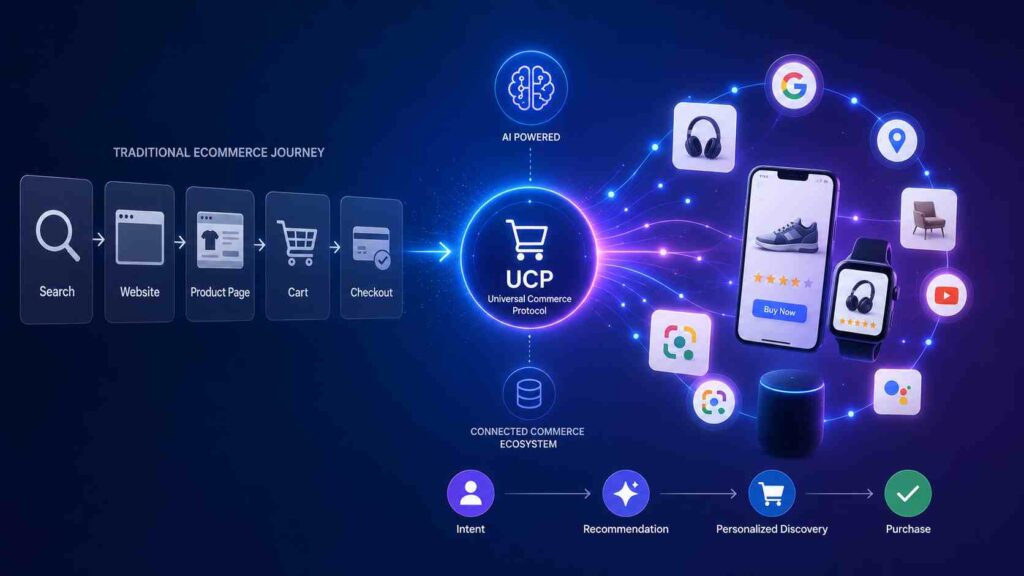
Historically, ecommerce platforms have operated independently. Product data often remains fragmented across websites and marketplaces. Google’s vision appears different. Universal Commerce Protocol (UCP) aims to create a more connected commerce ecosystem where AI-powered systems can discover, recommend and surface products more effectively. Combined with AI search capabilities and personalized shopping experiences, UCP could reduce friction between product discovery and purchase.
The future shopping journey may look very different from today’s ecommerce funnel.
Instead of:
Search → Website → Product Page → Cart → Checkout
Users may increasingly experience:
Intent → Recommendation → Personalized Discovery → Purchase
This shift could significantly change how brands think about customer acquisition.
YouTube Advertising Is Entering A New Phase
YouTube remains one of the world’s most powerful advertising platforms.
Google Marketing Live 2026 demonstrated how AI is becoming deeply integrated into video advertising workflows.
One major theme was creative efficiency.
AI-generated creative tools now help advertisers produce:
- Video assets
- Visual variations
- Ad creative adaptations
- Audio content
- Personalized experiences
Google also expanded support for product feeds across YouTube environments and devices. This includes broader shopping integrations that allow users to move more easily from content consumption to product discovery.
For ecommerce brands, this trend reinforces the importance of:
- Merchant Center optimization
- Product feed quality
- Video content strategies
- AI-enhanced creative production
The future of YouTube advertising is increasingly commerce-driven.
Performance Max Continues To Evolve
Performance Max remains central to Google’s automation strategy. Several updates announced at Google Marketing Live focused on making Performance Max more intelligent and efficient.
One standout improvement was Smart Bidding Exploration. Google reported that advertisers using this feature achieved approximately 27% more unique converting users. The significance lies in how the system operates. Traditional optimization focuses on known opportunities.
AI-powered optimization explores new opportunities. This allows advertisers to uncover demand that might otherwise remain invisible. Google also announced enhancements to campaign budgeting and attribution. Campaign Total Budgets reportedly reduced manual budget adjustments by approximately 66%.
These improvements move marketers further away from manual optimization and closer to strategic oversight.
Data Talks: Google Marketing Live 2026 By The Numbers
| Metric | Reported Impact |
|---|---|
| AI Max Conversion Lift | 7% |
| AI Max Early Testing Lift | 14% |
| AI Max Keyword-Based Campaign Lift | Up to 27% |
| Demand Gen ROI Improvement | 9.5% |
| Demand Gen Product Feed Conversion Growth | 33% |
| Smart Bidding Exploration Growth | 27% |
| Campaign Budget Adjustment Reduction | 66% |
| AI Overviews Monthly Users | 2 Billion+ |
These numbers reveal a consistent pattern. Google’s AI systems are being designed to improve efficiency, discover new opportunities and reduce manual campaign management.
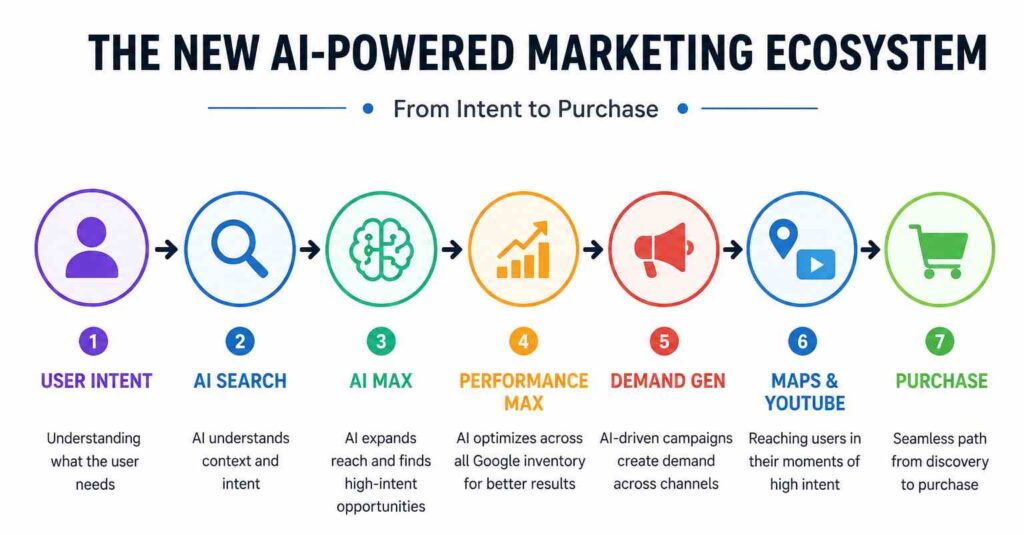
Traditional Digital Marketing vs AI-Driven Marketing
| Traditional Marketing | AI-Driven Marketing |
|---|---|
| Keyword Targeting | Intent Targeting |
| Manual Optimization | AI Optimization |
| Static Creative | Dynamic Creative |
| Separate Channels | Connected Ecosystems |
| Manual Budgeting | Predictive Budgeting |
| Campaign Management | Strategic Guidance |
My Biggest Takeaways From Google Marketing Live 2026
After reviewing the announcements, five insights stand out.
1. Keywords Are Becoming Less Important Than Intent
Google repeatedly demonstrated systems designed to understand what users mean rather than what they type.
2. Creative Is Becoming The New Competitive Advantage
As targeting becomes automated, creative quality becomes one of the strongest differentiators.
3. First-Party Data Is Becoming More Valuable
Businesses with strong customer data will likely gain the most from AI-powered optimization.
4. Search, Shopping And Advertising Are Merging
Google’s ecosystem is becoming increasingly interconnected.
Discovery, recommendation and purchasing are moving closer together.
5. AI Will Not Replace Marketers
AI will replace repetitive marketing tasks.
Strategic thinking, customer understanding and brand positioning will become even more valuable.
Conclusion:
Google Marketing Live 2026 was not simply a product showcase. It was a glimpse into Google’s long-term vision for digital marketing.
AI Max, Performance Max, Demand Gen, Google Maps advertising, Universal Commerce Protocol and AI-powered creative tools all point toward the same destination: a marketing ecosystem driven by intent, automation and personalization.
The marketers who thrive in this environment will not be those who resist AI. They will be the ones who learn how to guide it.
As digital marketing continues to evolve, success will depend less on manual execution and more on strategic decision-making, creative excellence and understanding customer behavior.
The future of AI in digital marketing is no longer approaching. It is already here!!!!
👉 Connect With Me
Thank you for reading.
I’m Anupam Das, a Digital Marketer with a strong interest in Google Ads, Performance Marketing, SEO, AI-powered marketing, Digital Marketing and emerging advertising technologies.
Through this blog, I share practical marketing insights, industry updates, campaign observations and my perspective on how platforms like Google are shaping the future of advertising and digital marketing.
If you found this article helpful, feel free to connect with me and follow my journey:
🌐 Website: https://dasanupam.com/
💼 LinkedIn: https://www.linkedin.com/in/digi-anupam/
📧 Email: [email protected]
I regularly publish content on SEO, AI Search, Digital Marketing, Marketing Automation and the evolving relationship between artificial intelligence and search engines.
Need Help Implementing These Strategies?
As AI continues to reshape search, advertising and customer acquisition, many businesses are finding it difficult to keep pace with rapidly changing platforms and technologies. Through dasanupam.com, I help businesses improve their online visibility through SEO, content strategy, website optimization and digital marketing consulting.
If you’re looking to strengthen your digital presence or explore AI-driven marketing opportunities, feel free to explore my services:
Pingback: AI Search Explained: How Google AI Search Is Changing SEO and Website Traffic - Anupam Das DIgital Marketing
Pingback: How to Do YouTube Keyword Research in 2026 | Anupam Das
Pingback: Google Analytics 4 in 2026 | Latest GA4 Updates | Anupam Das
Pingback: OpenAI Dots: 7 Powerful Features, Uses & Limits | Anupam Das