
YouTube Keyword Research in 2026

For years, YouTube keyword research followed a simple formula. Find a keyword with decent search volume. Add that keyword to your title. Mention it in your description. Publish the video and hope it ranks. This approach worked reasonably well when YouTube relied heavily on keyword matching to understand content. If your title contained the exact phrase a user searched for, there was a good chance your video could appear in search results.
Today, YouTube works very differently. The platform has evolved far beyond simple keyword matching. It now understands context, viewer intent and topical relevance at a much deeper level. Instead of asking whether a video contains a keyword, YouTube is increasingly focused on determining whether a video is the best answer to a user’s question.
A simple search demonstrates this shift.
Search for “best microphone for YouTube” and look at the top-ranking videos. You will often find titles such as:
- Best Microphone for Content Creation
- Best Wireless Mic Under 1000 for YouTube Videos
- 1000 Mic vs 35,000 Mic – What’s the difference
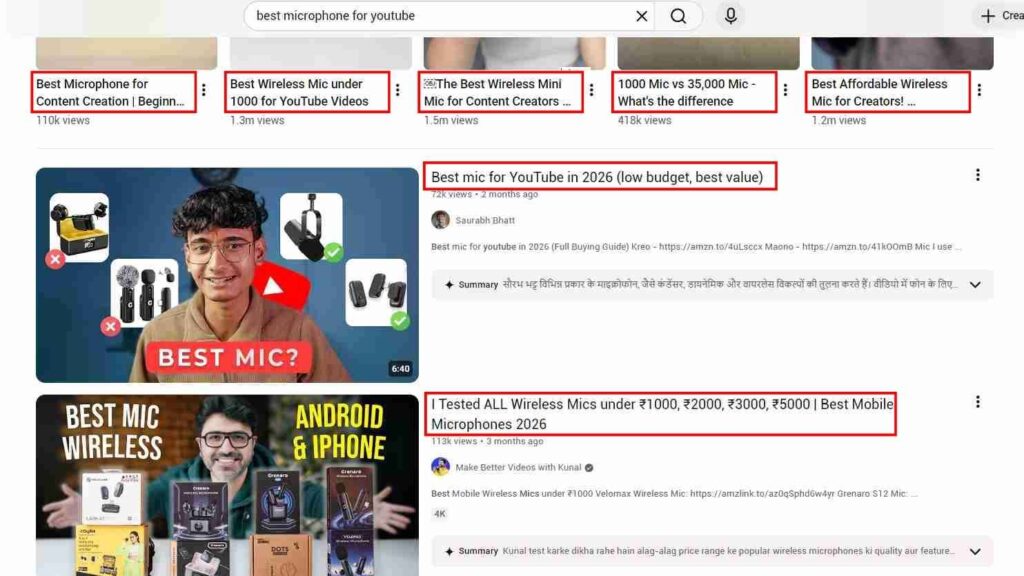
None of these titles are exact keyword matches. Yet they rank because YouTube understands they answer the same underlying question. This shift has important implications for creators, marketers and businesses investing in video content.
Unlike a blog post that can be updated and optimized over time, a YouTube video requires a significant investment upfront. Research, scripting, filming, editing, thumbnail creation and promotion all require time, effort and resources. If the topic is weak, the video often struggles regardless of production quality.
That is why YouTube keyword research in 2026 is no longer about chasing keywords. It is about validating topics, understanding audience demand, analyzing competitors and creating content that solves a problem better than existing videos.
As a digital marketer, I have noticed that the channels growing consistently are rarely the ones chasing individual keywords. Instead, they focus on becoming the most trusted and relevant source for topics their audience genuinely cares about.
Key Takeaways
Before diving deeper, here are the most important lessons from modern YouTube keyword research:
- YouTube understands topics and search intent better than ever.
- Search volume alone should never determine your content strategy.
- Topic validation is more valuable than idea generation.
- Packaging often influences performance more than keyword placement.
- Competitor research can reveal opportunities that keyword tools miss.
- Google Trends and YouTube Search provide direct insight into audience behavior.
- AI can assist with ideation but cannot replace audience understanding.
- The best videos align audience demand, channel expertise and business value.
Why YouTube Keyword Research Has Changed
One of the biggest misconceptions about YouTube SEO is that rankings are primarily driven by keywords. While keywords still help YouTube understand a video’s topic, they are only one signal among many. Unlike traditional search engines, YouTube is designed to maximize viewer satisfaction. The platform wants users to stay engaged, continue watching and return for future sessions.
To achieve that goal, YouTube evaluates factors such as:
- Watch time
- Audience retention
- Click-through rate
- Viewer satisfaction
- Session duration
- Topical relevance
This means creators can rank for searches even when they do not use the exact phrase in their title. For example, when someone searches for “best microphone for YouTube”, YouTube understands the user is looking for recommendations, comparisons and buying advice. A video that effectively answers those needs may rank higher than a video that simply repeats the keyword multiple times. This changes the purpose of keyword research.
Instead of asking:
“What keyword should I target?”
Creators should ask:
“What problem is the audience trying to solve?”
The answer to that question often reveals better opportunities than keyword volume alone.
Interestingly, this shift is not limited to YouTube. Search engines are also becoming better at understanding intent rather than relying solely on exact-match keywords. I recently explored this trend in detail in my article on AI Search Explained: How Google AI Search Is Changing SEO and Website Traffic, where I discuss how modern search experiences are evolving around context, conversation and user intent.
Why Search Volume Can Be Misleading
Many creators become obsessed with search volume. A keyword with thousands of monthly searches looks attractive. More searches should mean more views, right?
Not necessarily. High-volume keywords are often highly competitive and attract broad audiences with mixed intentions.
Consider these two examples:
- Best Camera Settings
- Best Camera Settings for Real Estate Photography
The first keyword may have significantly higher search volume. However, the second keyword targets a much more specific audience. The viewers searching for it know exactly what they want and are more likely to engage deeply with the content. For a photography creator, the second topic may produce better retention, stronger subscriber growth and more business opportunities. This is why search volume should be viewed as a validation metric rather than a decision-making metric.
Successful creators evaluate:
- Demand
- Competition
- Audience fit
- Business value
- Production feasibility
Search volume is only one piece of the puzzle.
Topic Validation Matters More Than Keyword Discovery
One of the most important shifts creators can make is moving from keyword hunting to topic validation. Instead of searching for random keywords with high volume, start with topics you can genuinely own. Then validate whether those topics deserve your time and resources.
Effective topic validation involves four critical elements.
1. Demand
Demand answers a simple question:
Do people care about this topic?
Demand can be measured using:
- YouTube autocomplete
- Google Trends
- Keyword research tools
- Competitor performance
If there is little evidence of interest, the topic may not be worth pursuing.
2. Channel Fit
A topic can have strong demand and still be the wrong choice. Imagine a digital marketing channel suddenly publishing gaming reviews. Even if the topic has massive search volume, it may confuse subscribers and weaken channel positioning.
The strongest content reinforces audience expectations.
3. Format Fit
Different topics require different formats. Some topics work well as talking-head videos.
Others require:
- Product testing
- Demonstrations
- Tutorials
- Comparisons
- Case studies
If you cannot realistically create the format viewers expect, the opportunity may not be worth pursuing.
4. Business Value
The best topics support both audience growth and business goals.
Strong videos often contribute to:
- Brand authority
- Audience growth
- Product awareness
- Lead generation
- Service promotion
A topic with moderate demand but high business value may outperform a high-volume topic that contributes little to long-term growth.
How To Find Better YouTube Video Ideas
Great content ideas often come directly from audience behavior.
1. Use YouTube Autocomplete
Start with a broad topic and observe the suggestions YouTube provides.
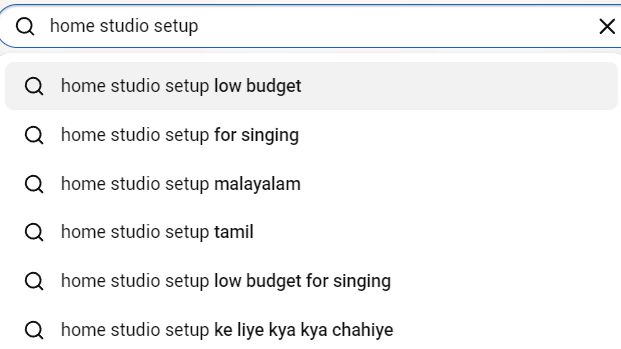
For example:
“Home Studio Setup”
may generate:
- Home Studio Setup for Beginners
- Home Studio Setup Under $500
- Home Studio Setup for YouTube
These suggestions represent real searches from real users. That makes them extremely valuable.
2. Use The Alphabet Method
A simple extension of autocomplete is the alphabet method.
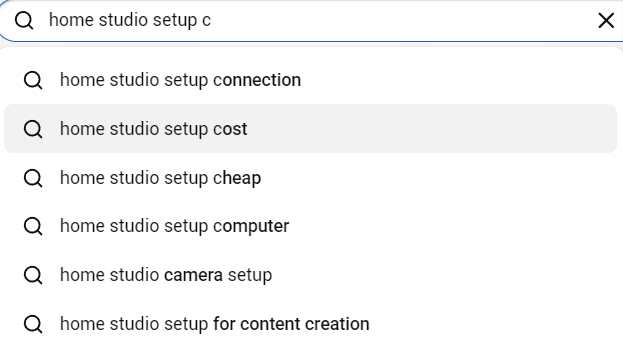
Add a letter after your topic:
- Home Studio Setup A
- Home Studio Setup B
- Home Studio Setup C
Each variation can reveal new opportunities. This technique often uncovers ideas that keyword tools never surface.
3. Analyze Trends
Google Trends provides additional context.
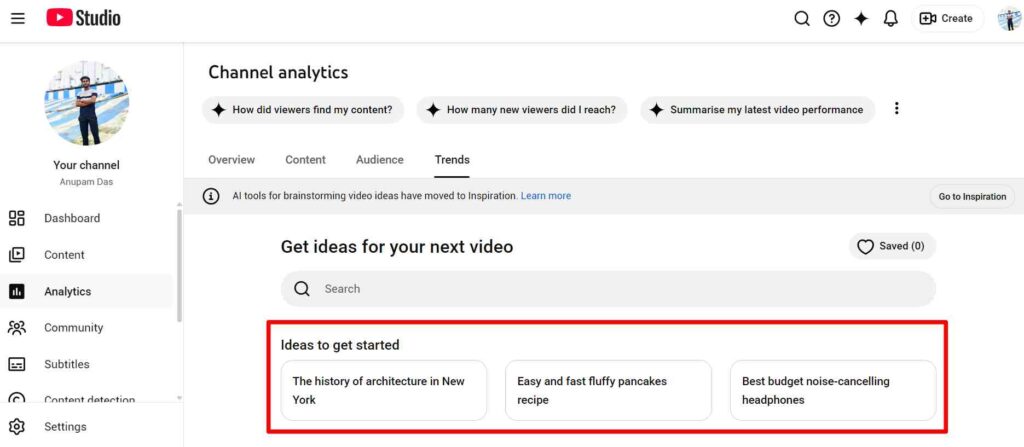
Instead of asking whether a topic has demand, ask:
- Is demand growing?
- Is demand seasonal?
- Is demand declining?
Timing can dramatically influence performance. A well-timed video on a growing topic often outperforms a better-produced video published at the wrong moment.
Why Competitor Research Is Still Underrated
Many creators spend hours inside keyword tools but only minutes studying successful competitors. That is a mistake. Competitor research can reveal insights that no keyword tool can provide.
Look for:
- Their most popular videos
- Their thumbnail styles
- Their title structures
- Their content formats
- Their audience questions
Pay particular attention to videos that significantly outperform the channel average. When a video receives five or ten times more views than typical content, it usually signals a winning combination of topic, timing and packaging.
Also examine comment sections. Viewers frequently ask follow-up questions that can inspire future content ideas. Sometimes the best video opportunity is hidden inside a comment that nobody has answered yet.
Common YouTube Keyword Research Mistakes
Many creators unknowingly sabotage their growth before they even start filming.
Here are some of the most common mistakes.
1. Chasing Search Volume
High search volume does not automatically equal opportunity.
Volume without relevance rarely leads to long-term success.
2. Ignoring Audience Expectations
A topic may be popular but completely irrelevant to your audience.
Growth becomes difficult when viewers do not know what your channel represents.
3. Copying Competitors Blindly
Successful videos can provide inspiration.
They should not become templates for copying.
Your goal should be understanding why a video succeeded rather than duplicating it.
4. Ignoring Business Value
Some topics generate views but contribute little to business goals.
A video strategy should support both audience growth and long-term objectives.
5. Optimizing Only For Search
Many creators focus exclusively on rankings.
However, rankings alone do not guarantee success.
If viewers do not click or watch, rankings become meaningless.
Packaging Often Beats Keywords
One of the biggest lessons in modern YouTube marketing is that viewers click ideas, not keywords.
Consider these examples:
| Basic Title | Stronger Packaging |
|---|---|
| Best Microphones for YouTube | If I Bought a Microphone in 2026, I’d Do This |
| Wireless Microphone Review | I Tested 36 Wireless Microphones… Here Are The Best |
| Home Studio Setup | My $500 Home Studio Setup in 2026 |
| Video Editing Software | Which Editor Saves Me 10 Hours Every Week? |
Notice what makes the stronger versions effective.
They create:
- Curiosity
- Credibility
- Specificity
- Emotion
- Relevance
People rarely click because of a keyword. They click because they believe the video will solve a problem or provide valuable insight. This is why packaging deserves as much attention as research itself.
A strong topic with weak packaging often underperforms.
A strong topic with excellent packaging can significantly outperform expectations.
This focus on audience intent and content packaging is becoming increasingly important across Google’s ecosystem. During Google Marketing Live 2026, Google highlighted several updates that point toward a future where discovery is driven more by context, behavior and user intent rather than exact keyword matching. I recently analyzed these announcements in my article on Google Marketing Live 2026 and explored what they could mean for creators, marketers and brands looking to stay visible in an evolving digital landscape.
How AI Can Support YouTube Research
AI has become a useful assistant during the research process.
However, it should be viewed as a support tool rather than a strategy tool.
AI can help with:
- Generating title ideas
- Creating video outlines
- Brainstorming thumbnail concepts
- Expanding topic angles
- Organizing research
What AI cannot reliably do is understand your audience as deeply as you do.
It does not know your channel history, audience preferences or business goals. The best approach is to use AI after validating a topic. Let data guide the topic selection and use AI to improve execution.
A Simple YouTube Topic Scoring Framework
Before producing a video, evaluate it across these factors:
| Factor | Weight |
|---|---|
| Demand | 25% |
| Competition | 20% |
| Channel Fit | 10% |
| Format Fit | 10% |
| Business Value | 25% |
| Urgency | 10% |
This framework helps prevent creators from investing time in topics that look attractive on the surface but fail to support broader goals.
My Perspective As A Digital Marketer
One trend I continue to observe across YouTube, SEO and digital marketing is that platforms are becoming better at understanding intent. Algorithms are improving. Audience expectations are evolving. Competition is increasing. Yet the fundamental principle remains unchanged.
People want useful content. The creators who consistently grow are rarely the ones stuffing keywords into titles and descriptions. They are the ones who deeply understand their audience and repeatedly solve meaningful problems.
Keyword research remains important. However, its role has changed. It is no longer a content generation tool. It is a validation tool. The strongest channels combine data, audience understanding and consistent execution. When those elements work together, growth becomes much more sustainable.
Conclusion
YouTube keyword research in 2026 is no longer about chasing exact-match keywords. The platform has evolved beyond simple keyword matching and increasingly rewards topical relevance, audience satisfaction and content quality. The most successful creators begin with topics they can credibly own. They validate demand, study audience behavior, analyze competitors and package their content in ways that stand out in crowded search results.
Search volume still matters. Keywords still matter. But neither should be the starting point. The best creators think about problems first and keywords second. They focus on becoming the most useful answer to a topic rather than the best-optimized result for a keyword. In a world where thousands of videos are uploaded every minute, that mindset can be the difference between publishing content that disappears and building a channel that continues to grow over time.
As a digital marketer, I believe the future belongs to creators who combine research, audience understanding and strategic execution. Those who focus only on keywords may still find occasional success. Those who focus on topics, value and audience trust are far more likely to build sustainable growth on YouTube in the years ahead.
👉 Connect With Me
Thank you for reading.
I’m Anupam Das, a Digital Marketer with a strong interest in SEO, AI Search, Paid Ads & Performance Marketing, Marketing Automation, and emerging technologies shaping the future of digital marketing.
Through this blog, I share research-backed insights and my own experience in Youtube Keywords Research to improve performance of videos and shorts and how these strategies impacting the search in Youtube.
If you found this article helpful, feel free to connect with me and follow my journey:
🌐 Website: https://dasanupam.com/
💼 LinkedIn: https://www.linkedin.com/in/digi-anupam/
📧 Email: [email protected]
I regularly publish content on SEO, AI Search, Digital Marketing, Marketing Automation and the evolving relationship between artificial intelligence and search engines.
Need Help Implementing These Strategies?
As AI continues to reshape search, advertising and customer acquisition, many businesses are finding it difficult to keep pace with rapidly changing platforms and technologies. Through dasanupam.com, I help businesses improve their online visibility through SEO, content strategy, website optimization and digital marketing consulting.
If you’re looking to strengthen your digital presence or explore AI-driven marketing opportunities, feel free to explore my services:
Pingback: Google Analytics 4 in 2026 | Latest GA4 Updates | Anupam Das
Pingback: OpenAI Dots: 7 Powerful Features, Uses & Limits | Anupam Das